
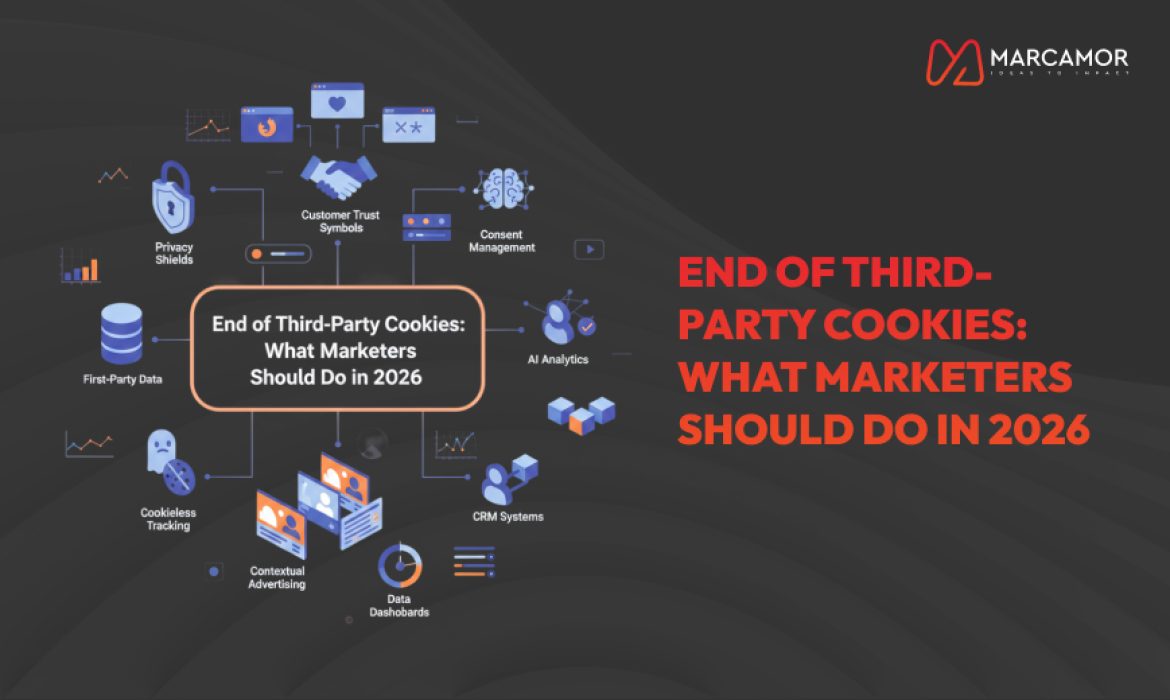
End of Third-Party Cookies: What Marketers Should Do in 2026
As 2026 approaches, marketers across industries are facing a major shift in how data is collected, audiences are targeted and performance is measured. This change is forcing brands to rethink Digital Marketing strategies that once depended heavily on third-party tracking. Those who adapt early will gain a clear advantage, while those who delay risk losing visibility, personalization and revenue in a cookieless world.
What Happens When Third-Party Cookies Are Removed
When third-party cookies are removed, marketers lose the ability to track users across multiple websites. This directly impacts ad targeting, retargeting campaigns and cross-channel attribution models. Many of the familiar audience insights marketers relied on become less accurate or disappear entirely, making it harder to understand user behavior at scale.
The removal also changes how personalization works. Without third-party data, brands can no longer depend on external signals to customize messaging. This forces marketers to shift their focus inward, relying more on direct relationships with users and transparent data collection methods. While this may feel limiting at first, it ultimately creates a more sustainable and privacy-friendly marketing ecosystem.
How the Cookie less Future Will Affect Marketers in 2026
The cookieless future affects nearly every digital marketing channel. Paid advertising becomes less dependent on behavioral tracking and more focused on contextual relevance and first-party audiences. Analytics and attribution models evolve, using aggregated and modeled data rather than individual user tracking.
Marketers in 2026 will need to place greater emphasis on trust, consent and value exchange. Consumers are more aware of how their data is used and brands that respect privacy are more likely to build long-term loyalty. The cookie less shift also pushes marketers to improve content quality, SEO and owned media channels, which are less affected by cookie deprecation.
How to Market Without Third-Party Cookies
Marketing without third-party cookies requires a mindset shift rather than a complete rebuild. First-party data becomes the foundation of digital strategy, collected through websites, email subscriptions, gated content and direct interactions. This data is more accurate, compliant and valuable because it comes directly from engaged users.
Contextual advertising also plays a larger role, allowing brands to reach relevant audiences based on content rather than behavior. At the same time, zero-party data, such as preferences shared through surveys or quizzes, helps marketers deliver personalization without violating privacy expectations. Together, these approaches allow brands to remain effective even without third-party tracking.
Cookie less Marketing Strategies That Work in 2026
Successful cookieless marketing strategies in 2026 focus on transparency, relevance and long-term relationships. Privacy-first marketing is no longer optional, as regulations and consumer expectations continue to evolve. Marketers who invest in consent-based data collection and clear communication see stronger engagement and higher trust.
Analytics also adapts to this new reality. First-party analytics tools and modeled attribution help marketers measure performance while respecting privacy. Over time, brands that prioritize ethical data use and customer experience are better positioned to grow sustainably in a world without third-party cookies.
Conclusion
It is an opportunity to build stronger, more transparent relationships with customers while creating marketing systems that are future-proof and privacy-compliant. Marketers who act now by adopting first-party data strategies, contextual advertising and privacy-first analytics will be far better prepared for what lies ahead. Platforms and agencies like Marcamor are already helping brands navigate this transition by focusing on data-driven yet privacy-conscious marketing approaches. The marketers who succeed in 2026 will not be those chasing old tracking methods, but those embracing trust, innovation and smarter data practices.
FAQs
Are third-party cookies still used in 2026?
Third-party cookies have very limited use in 2026, as most major browsers restrict or block them. While some legacy systems may still reference them, relying on third-party cookies is no longer a viable long-term strategy for marketers.
What replaces third-party cookies in marketing?
First-party data, zero-party data and contextual advertising replace third-party cookies. These alternatives allow marketers to reach relevant audiences while respecting user privacy and complying with regulations.
Is cookieless marketing effective for small businesses?
Cookieless marketing can be highly effective for small businesses because it emphasizes direct customer relationships, content quality, and owned channels. These approaches often deliver better ROI than expensive third-party data solutions.